Showing posts with label Galapagos. Show all posts

Sunday, November 22, 2009

Blue Footed Boobies and How You Can Save Them


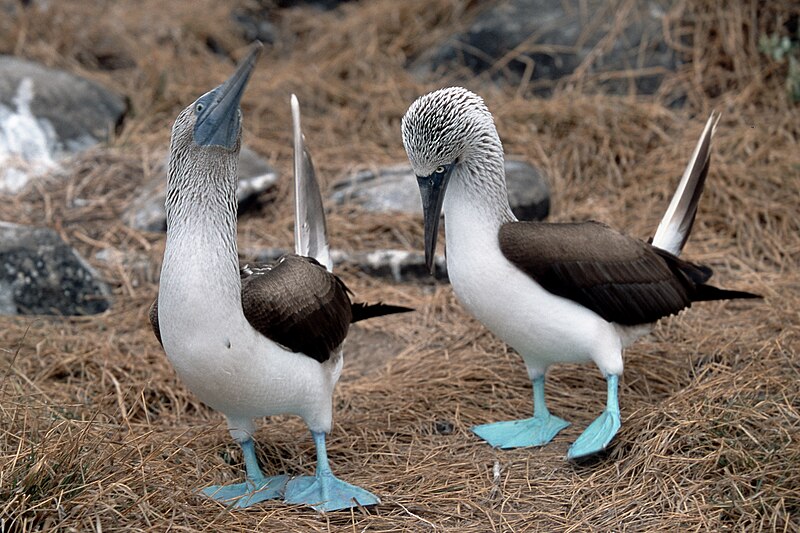
Blue footed boobies are memorable if not for their name (which comes from the Spanish word "bobo" meaning fool or clown, since blue footed boobies are clumsy on land) then for their blue feet which play a role in courtship - the bluer the better when it comes to attracting a mate!

Blue footed babies also exhibit some interesting parenting skills in the Galapagos. They nest on the ground and once the booby chick is hatched they leave it to fend for itself while they go off in search of food. Fortunately the blue footed booby has no predator so the booby chicks are safe - except for the flash of all the tourist's cameras, but the blue footed boobies don't seem to mind, some of them actually seem to appear to pose for the camera. Born stars!

Why Blue Footed Boobies Need Our Help

Fortunately blue footed boobies are considered a species of "least concern" by the IUCN. Their habitat is also protected and they have no predators so they are in better shape than many other species. However they do feed exclusively on fish so it is important to ensure the waters and marine life in the Galapagos are protected.

For more information on the Galapagos see: Travel to Galapagos, Galapagos at the Crossroads: Book Review, Fun Galapagos Giant Tortoise Facts and How We Can Save Them

Help Save Blue Footed Boobies

Blue footed booby photo courtesy of: Wikimedia Commons

Wednesday, November 4, 2009

Fun Galapagos Giant Tortoise Facts and How We Can Save Them


These fun Galapagos Giant Tortoise facts will focus on the world's most famous tortoise, Lonesome George. Lonesome George has a story that you won't soon forget. He is the last surviving turtle from Pinta Island. Researchers found him and moved him to the Charles Darwin Research Station where they put him in an enclosure with two females. You think that Lonesome George would be excited to see other tortoises after being alone for so long, especially females, but that was not the case. Lonesome George remained elusive, so elusive in fact that he was celibate for 60 years - talk about a dry spell!

In July he finally mated and a female laid eggs. I was fortunate enough to see George at the Charles Darwin Research Station in person a few weeks after this big adventure and waited anxiously with thousands of other people to see if the eggs would be fertile. In September researchers at the Charles Darwin Research Station announced that the eggs were fertile and moved the eggs to an incubator -YEAH! Galapagos giant tortoises live up until 150 - 200 years so Lonesome George still has quite a few years left but hopefully he will live on long after his passing. I can't wait to see what the little Lonesome George's will look like.
Sources: Galapagos Giant Tortoise, Galapagos Conservation Trust
Further reading about visiting the Galapagos : Galapagos Travel

Why Galapagos Giant Tortoises Need Our Help
In the 18th and 19th many tortoises were killed for food by whalers and believe it or not - pirates. Tortoises can go months without food and water so they were the perfect food for long voyages. Then another culprit was introduced. Any guesses? Believe it or not, the goat. Goats multiplied quickly, destroying all the vegetation so Galapagos Giant Tortoises literally starved to death with nothing to eat. The largest animal eradication on earth occurred on Santa Cruz Island where 100,000 goats were eradicated by sharp shooters from the air. It is a fascinating story and I would encourage you to read Galapagos at the Crossroads for more of the story along with other threats to the Galapagos Giant Tortoises and the Galapagos in general. Today, all Galapagos Giant Tortoise eggs are incubated at the Charles Darwin Research Station and then when the tortoises are old enough to survive they're released back into the wild.

Help Save Galapagos Giant Tortoises